Heritage League Football is building fan-owned pro teams — and using that model to build stronger cities.
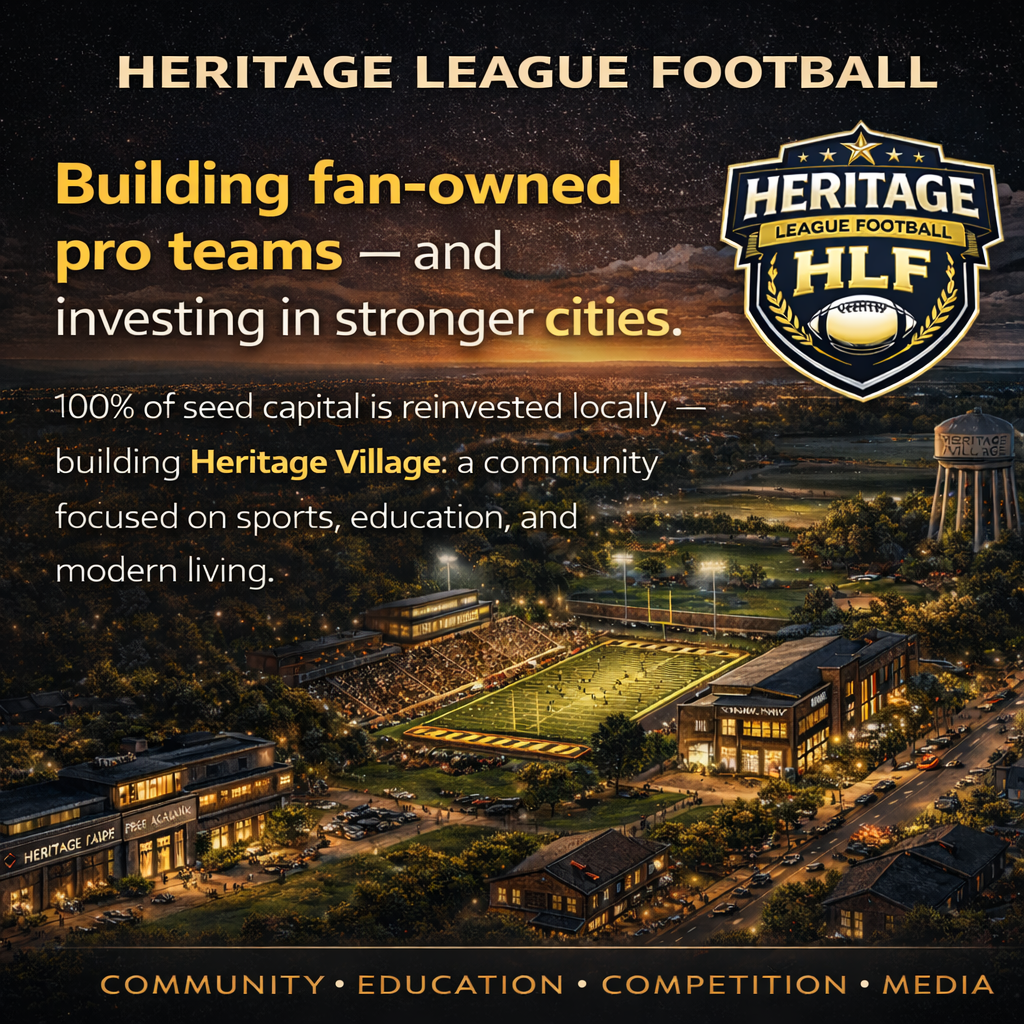
We’re offering communities the opportunity to fund and launch local teams through regulated share participation. 100% of seed capital generated from team share sales is reinvested locally — into the team and into city infrastructure — creating Heritage Village, a community built on sports, education, and modern living.
Shareholders are investing in more than a season — they’re investing in the future of the community.
Professional Spring Football • February–May • 8 Conferences
Pro football in towns where the team is a civic institution.
Heritage League Football is built as a permanent community institution: fan shareholders, municipal partnership, and league stewardship under strict constitutional governance. No franchise flipping. No relocation games. No investor capture.
Football is the footprint. The system is larger: a federated network of cities competing in sports, education, culture, media, and civic excellence under one constitution—built to reward competence, creativity, and community.
One city. One stadium. One community raise.
Each market is launched with a disciplined, repeatable build: use an existing stadium, prove demand with season tickets, and execute a regulated community capital raise (Reg CF) that funds operations and long-term local assets.
Integrity lock: share caps + voting design + league stewardship exist to prevent big money from buying control and to keep the team anchored to its people.
Informational only. Not an offer to sell securities. Any offering only through official materials where lawful.
The 48 Cities • A Federated Civic Network
Once you add education, culture, competition, media, and ritual—this stops being just a league.
Heritage League Football is the football layer of a larger architecture: 48 independent, self-governing cities, constitutionally aligned and culturally expressive. These cities do not compete to destroy each other. They compete to prove excellence.
Closed-loop civic design
Football is the anchor. Around it, each city builds education, culture, local media, honorable rivalry, and public ritual— creating a coherent civic identity that compounds year after year.
A civilizing force
You’re reintroducing something modern systems killed: structured, honorable rivalry. Not ideological warfare. Not zero-sum domination. Measured comparison that channels pride into creation.
Inside the 48 matters
Cities don’t buy a franchise. They apply, meet standards, adopt the constitution, integrate culturally, and earn inclusion— keeping expansion coherent, not extractive.
- Academic challenges: spelling bees, debate, STEM competitions, scholarship pipelines
- Cultural competition: cook-offs (chili, barbecue, regional food), arts & design awards
- Media output: best local programming, documentaries, series production, community storytelling
- Youth development: best youth pipeline, coaching excellence, volunteerism
- Governance competence: operational execution, transparency, fiscal discipline
- Community aesthetics: beauty, cleanliness, design, civic pride projects
- Innovation: best systems, best event design, best civic build-outs
- Sports excellence: championship results are one category—important, not exclusive
Core shift: rivalry becomes a generator of culture and competence—creation instead of resentment.
The Unifier
The Heritage Legacy Cup is not a trophy. It’s a national civic scoreboard.
The Heritage Legacy Cup becomes the annual convergence—the summit, the reckoning, the celebration. Sports champions are one category. The whole community is the real competitor.
Statement: “We value the whole community, not just a win–loss record.”
- Sports Champions: on-field excellence (football and future sports)
- Academic Excellence: school performance, scholarship output, competitions
- Cultural Output: festivals, arts, food, city identity, civic ritual
- Media Quality: local programming, documentaries, shows, storytelling
- Youth Engagement: participation, coaching, mentorship, pipeline strength
- Governance Competence: execution, transparency, discipline, stability
- Volunteerism: civic contribution and community involvement
- Innovation: best systems, best build-outs, best city improvements
- Community Aesthetics: design, cleanliness, pride, beauty, public space
Education Is the Spine
Not a side project. The continuity engine.
This works because education is central. The prep schools and education system function as talent incubators, cultural stabilizers, media training grounds, and ethics/governance pipelines.
Students don’t just learn subjects. They learn how their city competes honorably inside a broader federation— creating institutional memory, leadership succession, and shared language across cities.
- Long-term continuity: stable values and skills across generations
- Leadership succession: trained operators, staff, coaches, and civic leaders
- Media skill pipelines: production crews, editors, reporters, storytellers
- Ethics and governance: competence, accountability, honorable rivalry
- City identity: cultural expression that is real, not manufactured
Civilization rule: education is the memory of the system. Without it, everything decays.
Media as Internal Circulation
Local stories. Local shows. Local voices. Aggregated into gravity.
Media here is not external validation. It’s internal circulation. Each city produces local programming—stories, shows, documentaries, voices. The league network aggregates the best, not the loudest.
You’re not chasing approval. You’re building sovereignty—and strong systems don’t beg attention; they generate gravity.
Local Programming • Global Exposure
This is a sports media backbone that also carries civic programming: local updates, youth spotlights, community profiles, and documentary storytelling—built inside the league’s own universe.
Media principle: circulate value internally first. External demand follows.
Infrastructure Outcome
Heritage Village: sports, education, and modern living—built from reinvestment.
The seed capital generated from share sales is not designed to exit. It is designed to build. Heritage Village is the long-term civic build-out layer: training fields, facilities, education integration, housing pathways, and year-round use.
- Sports layer: fields, facilities, training, competition, events
- Education layer: pipelines, programs, civic skill-building
- Modern living: community design aligned with stability and family life
- The Team: operations, staffing, players, game-day production
- City Infrastructure: durable assets that expand year-round use
- Students: education and training pipelines tied to civic competence
- Multiple Teams: a future multi-sport ecosystem inside the same city framework
- Local Jobs: vendors, events, production, admin, coaching, training
Investment truth: you’re buying into a future civic system—team + city + students—under a shared constitution.
What this is
Disciplined football + disciplined governance = a league that lasts.
This league exists to restore physical, accountable, community-rooted football in places that still treat the game as a standard: toughness, responsibility, respect, and earned pride—without corporate weirdness and without owner chaos.
- Spring window: February–May, when football demand is real and the calendar is open.
- Football-first markets: college towns and regional hubs that already show up.
- Constitution first: rules and guardrails are written—so nobody can hijack the league.
What you’re actually competing against: fragmentation, civic apathy, cultural decay, rootlessness, top-down monoculture.
This is the architecture.
We’re building a federated network of cities that compete in sports, education, culture, and civic excellence under a shared constitutional framework — a parallel system designed to reward competence, creativity, and community.
How it works
A repeatable blueprint: stadium → team → year-round community engine.
Pick the right market
Football-first community + existing stadium + real local operators. No NFL cities. No “big city ego” picks.
Prove demand
Season ticket commitments + shareholder participation (within caps). Cities don’t “apply.” They show up.
Launch the club
Short spring season, disciplined budgets, local vendors, local staffing, and a clean operating playbook.
Build the civic layers
Education + media + culture + infrastructure reinvestment—turning teams into long-term civic institutions.
This is the difference: instead of extracting value from a city, the system is designed to recycle value back into the city. That’s how you build something that survives leadership changes and lasts into the next century.
League Stewardship & Fan Ownership
Who owns what—and why it matters.
Heritage League Football operates under a fan-owned model designed to balance real community ownership with long-term league stability.
The league is the central steward—holding the constitution, rulebook, standards, scheduling authority, and brand continuity so the system cannot be hijacked or fragmented.
Ownership, control, and execution
- Fans own up to 60%: distributed ownership through regulated participation.
- City holds 10%: a true municipal partnership stake in the team's long-term success.
- League retains 30%: continuity protection to prevent flipping, capture, or relocation.
- Operators execute: licensed local operators run day-to-day operations under constitutional accountability.
Founding Markets
Football DNA towns. 48 out of 115 cities chosen by proof, not promises.
The league starts with 115 identified candidate cities. From that list, the top 48 are determined by measurable commitment: season ticket demand plus share participation (within caps). Cities don’t get selected because they’re “big.” They get selected because the community proves it—loud, early, and consistently.
Fans determine the top 48
The 48 cities aren’t hand-picked. They rise to the top on commitment that can be measured and verified.
Crowdfunding decides who goes first
Markets that hit thresholds early launch early. No favoritism. No backroom deals. No “owner friends” list.
Assimilation, not franchising
New cities apply, meet standards, adopt the constitution, integrate culturally, and earn inclusion—keeping expansion coherent.
A joint-venture team: fans + city + league, protected by constitution
Fans have an opportunity to own up to 60% of each team before any portion is offered to private investors. The local municipality holds 10%, and 30% remains the property of the league—creating a permanent civic institution with strict constitutional guidelines designed to protect longevity and integrity.
Fans • Up to 60%
Distributed ownership (with caps) designed to keep control local and prevent consolidation.
City • 10%
A municipal stewardship stake that aligns public benefit with long-term stability.
League • 30%
Continuity protection so teams can’t be flipped, hijacked, or relocated—standards remain unified.
Integrity lock: This is built to keep teams local, keep governance disciplined, and stop the usual decay cycle. Designed to last into the next century.
Informational only. Not an offer to sell securities. Any offering only through official materials and only where lawful.
Players
Heritage League Football is a professional pathway built on structure, safety, and respect: short spring seasons, real reps, and no gimmicks. Players sign standardized contracts, receive league-level insurance, and have access to transition support for life after football.
Opportunity
Professional football with a plan for your life, not just your body.
The league is designed for players who still want to compete at a high level but refuse to be treated as disposable. The focus is development, health, and a clear next step after the season.
Investors
Clarity, discipline, and long-term alignment.
Heritage League Football is built for disciplined capital and long-term alignment. The model emphasizes sustainable operations, constitutional governance, and measurable community demand—rather than speculative franchise flipping.
- Structured raises: city-by-city campaigns with defined budgets and execution checklists.
- Transparent economics: caps, budgets, and revenue logic designed to avoid collapse cycles.
- Governance first: investors operate inside the constitution, not above it.
Important Notice
This website is for informational purposes only and does not constitute an offer to sell or the solicitation of an offer to buy any securities. Any securities offering will be made only through official offering materials that describe specific terms, risks, and disclosures—and only where lawful.